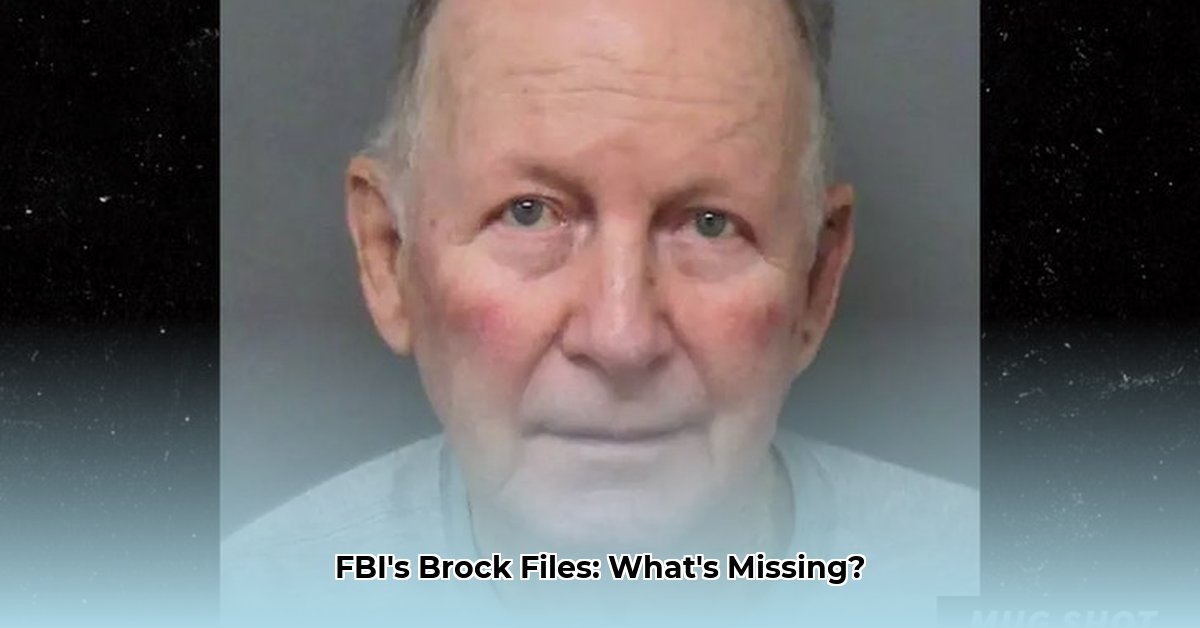
Unraveling a Partial History: The William Brock FBI File
The quest to access and understand William Brock's FBI file reveals a frustratingly incomplete picture. While the existence of the file itself confirms FBI interest in Brock, the specifics of the investigation remain elusive, creating a puzzle with numerous missing pieces. The available documents offer tantalizing glimpses but fall far short of providing a coherent narrative. This review examines the known limitations of the accessible materials and outlines steps toward a more complete understanding.
The Challenges: Fragmentation and Uncertainty
Several factors complicate the analysis of the William Brock file. The digitized files themselves suffer from poor quality, akin to attempting to discern details from a blurry photograph. Further complicating matters, the FBI acknowledges that the records may reflect investigative techniques now deemed outdated or unreliable, potentially introducing bias and inaccuracies. The lack of a clear narrative within the documents exacerbates the issue, creating a disjointed account difficult to piece together. This fragmented nature prevents a comprehensive analysis and renders definitive conclusions impossible. Critical context, essential for interpreting the available information, remains largely unavailable.
What We Know, and the Vast Unknown
The presence of an FBI file bearing William Brock's name definitively establishes that an investigation occurred. However, the specifics of this investigation—its objectives, methodology, and ultimate conclusions—remain shrouded in mystery. The available records fail to provide a clear timeline or definitive answers. The limited archival material severely restricts analysis, and the absence of crucial background information further hinders understanding. This poses significant limitations on the interpretation of the available data. The currently accessible information only presents a partial and potentially biased view of events.
A Collaborative Path Forward: Toward a More Complete Understanding
To move forward, a multi-faceted approach is necessary. Historians and researchers must continue advocating for access to the complete, unredacted files. Archivists need to improve the organization, digitization, and description of historical documents to enhance accessibility and clarity. Public advocacy for greater transparency in government records is also crucial in facilitating a more complete understanding of this historical puzzle. The pursuit of the full truth surrounding William Brock’s FBI file requires a sustained collaborative effort.
Actionable Steps: A Timeline for Progress
The following timeline outlines key actions needed by various stakeholders to progress further in the search for the complete story.
| Stakeholder | Short-Term Goals (Next 1-2 Years) | Longer-Term Goals (3-5 Years and Beyond) |
|---|---|---|
| Historians/Researchers | Exhaustive search for additional primary and secondary source materials; advocacy for full file access. | In-depth analysis of related court records, news articles, and other supplementary materials to contextualize the FBI file. |
| Archivists | Enhanced file descriptions; improved digital access, including OCR improvements and metadata enrichment. | Preservation and repair of damaged files; development of improved access protocols for researchers, balancing preservation and accessibility. |
| The Public | Increased awareness of the gaps and limitations in currently accessible government information. | Advocacy for legislative changes promoting greater transparency and public access to governmental records. |
The investigation into William Brock's life, as reflected in the limited FBI file data, is a work in progress. The puzzle's pieces exist, but assembling and interpreting them requires substantial time, dedication, and collaborative effort from researchers, archivists, and the interested public.
Interpreting Incomplete Historical FBI Files: A Methodology
Accessing and interpreting historical FBI files, especially those available through online archives like the FBI Vault 1, presents a unique methodological challenge. The example of a hypothetical William Brock file highlights the complexities of working with incomplete data.
Key Considerations:
- Incomplete Archival Records: The FBI Vault, while a valuable resource, is not exhaustive. Documents may be missing, damaged, or redacted.
- Contextual Understanding: The historical context in which the files were created is critical for accurate interpretation.
- Source Corroboration: Cross-referencing FBI file information with other historical sources is essential for validation.
- Acknowledging Limitations: Transparency regarding data gaps and uncertainties is crucial for rigorous analysis.
Navigating the Archival Landscape: Strategies for Effective Research
Precise Research Questions: Formulating focused research questions maximizes the efficiency of archival searches. Broad inquiries often yield overwhelming, unmanageable results.
Strategic Search Techniques: Employ a multi-pronged approach. Combine keyword searches with subject indexing, using related terms and alternative spellings. Note that OCR limitations can impact search accuracy.
Contextual Analysis: Analyze the historical context surrounding the file’s creation. Consider prevalent political and social issues, investigative techniques, and biases of the time.
Cross-Referencing: Corroborate findings with independent sources like news articles, biographies, and court records to establish accuracy and identify potential biases or inconsistencies.
Transparency and Limitations: Explicitly acknowledge any missing information or uncertainties inherent in the incomplete nature of the archival data.
Analyzing Data: Mitigating Challenges
The following table outlines potential challenges and their mitigation strategies.
| Challenge | Potential Impact | Mitigation Strategy |
|---|---|---|
| Incomplete Information | Inaccurate or incomplete conclusions | Comprehensive cross-referencing; explicit acknowledgment of limitations |
| Redacted Material | Biased or incomplete picture; missing key details | Seeking alternative sources; contextual analysis; critical evaluation |
| OCR Errors | Misinterpretations due to inaccurate transcriptions | Manual verification of OCR results; multiple search strategies; consulting original documents if possible |
| Biased Language/Perspective | Inaccurate or skewed historical narrative | Comparing with alternative accounts; critical analysis; attention to historical context |
Effective interpretation of incomplete historical FBI files demands a thorough, methodical approach that accounts for the inherent challenges presented by archival limitations and potential biases.
⭐⭐⭐⭐☆ (4.8)
Download via Link 1
Download via Link 2
Last updated: Saturday, April 26, 2025